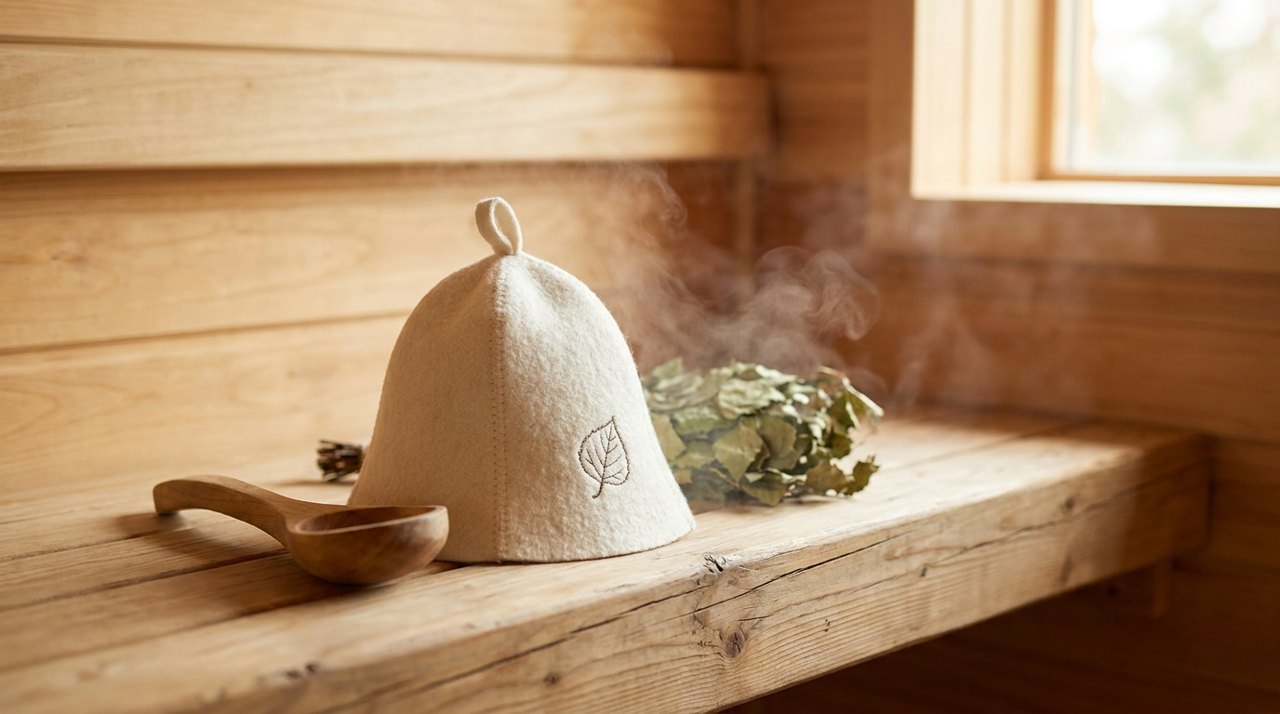
Walk into any traditional Russian banya and you'll see it immediately: grown adults sitting in 90°C steam wearing what look like felt wizard hats. To outsiders it reads as costume. To anyone who has spent time in a banya, it's as functional as oven mitts — and it carries several centuries of history on its brim. The banya hat, or shapka dlya bani, is one of the few pieces of peasant-era practical clothing that survived industrialization, the Soviet Union, and globalization essentially unchanged, and it's now quietly conquering saunas far beyond Russia.
The Russian banya itself is old — genuinely old. The Primary Chronicle, compiled around 1113, already describes bathers in Novgorod beating themselves with birch branches in wooden bathhouses so hot that observers thought it was a form of voluntary torture. For most of Russian history, the banya was a log hut with a stone stove, and the ritual was the same one practiced today: heat, steam thrown on the stones (par), a vigorous massage with leafy birch or oak whisks (venik), and a plunge into cold water or snow.
The hat entered the picture through practical necessity. Russian banya steam is wet steam — water ladled onto stones sends bursts of vapor toward the ceiling, where temperatures spike far above what the thermometer on the wall reads. Anyone standing or sitting on the upper bench takes that heat directly on the head and ears. Wet hair heats up fast, ears burn, and the bather is driven out of the steam room long before the rest of the body has had enough. Felt — cheap, abundant, and one of the oldest textiles in the Eurasian steppe tradition — solved this. A thick felt cap traps a layer of cooler air around the head, keeps the scalp several degrees below ambient, and lets the bather stay in longer and lower down the discomfort curve.
It's worth being precise about what the hat does, because the folklore around it is muddled: it doesn't keep you cool overall, and it doesn't prevent "brain overheating" in any medically dramatic sense. It insulates the head against the hottest air layer in the room and shields ears and hair, which is exactly enough to make long steam sessions comfortable. The physics is genuinely interesting — we've broken it down properly in Why Wear a Sauna Hat? The Benefits, Explained by Physics.
Felt-making (valyanie) was a village craft across Russia, the same craft that produced valenki, the felted wool boots that kept generations of Russians alive through winter. Banya hats came out of the same workshops and the same wool — often literally the offcuts. A peasant family's banya hats were rough, grey or brown, shaped over a wooden form, and passed around without much ceremony.
The aristocracy bathed too, and this is one of the banya's more remarkable social features: it was never exclusively a peasant institution. Nobles kept private bathhouses on their estates; merchants and officials frequented the great public banyas of Moscow and St. Petersburg, most famously the Sanduny baths, opened in 1808 and still operating. The wealthy version of the hat was finer — white felt, sometimes embroidered, occasionally trimmed — but structurally identical, because the physics didn't care about rank. In the steam room, a count and his coachman wore the same silhouette.
Understanding why the hat survived means understanding what the banya was for. It was never just hygiene. The pre-revolutionary banya was where major life events happened: brides were bathed and sung to before weddings, mothers gave birth there (it was the cleanest, warmest building in the village), the sick were treated, and business deals were sealed between rounds of steam. The saying went that the banya was a second mother — banya parit, banya pravit, the banya steams, the banya heals.
A typical session, then and now, follows a rhythm:
Notice the duration. A Russian banya visit is an afternoon, not a fifteen-minute sweat. The hat exists precisely because the culture demanded long, repeated, sociable exposure to aggressive steam. A quick-in, quick-out bathing culture would never have bothered inventing it.
The Soviet era, whatever else it flattened, left the banya alone. Public bathhouses were workers' institutions; the Friday banya with friends became a fixture of urban life (immortalized in the 1976 film The Irony of Fate, which every Russian household still watches on New Year's Eve). Felt hats, cheap to produce and impossible to improve upon, came along for the entire ride.
Finland and Russia share a long border, a long history, and two closely related bathing traditions that developed in parallel — the smoke saunas of Karelia sit culturally and geographically between the two. Yet the felt hat was historically a Russian and Eastern European habit, not a Finnish one. Traditional Finnish sauna runs drier, Finns tend toward shorter rounds, and the classic Finnish position on headwear was, roughly, that it was unnecessary.
That started shifting in the late twentieth century and accelerated fast in the last two decades. Estonian and Russian bathing culture bled into the Baltic sauna scene; German Aufguss culture — theatrical steam ceremonies with towel-waving that push heat loads well beyond a quiet Finnish löyly — created exactly the conditions the hat was invented for. Today felt hats hang in Helsinki's public saunas like Löyly and Kotiharju, sold in the lobby, worn without irony. The hat won the argument the same way it always had: people who wore one stayed in longer and enjoyed it more.
The current sauna wellness boom — backed by the Finnish cardiovascular research of Jari Laukkanen's group and carried by cold-plunge culture — has pulled the banya hat into its third act. Sauna studios from Berlin to Brooklyn now sell felt hats at the front desk, and the market has split into two tiers: cheap synthetic-blend novelty hats, and proper dense wool felt in the traditional mold. The difference matters; thin felt insulates poorly and synthetic blends can get unpleasantly hot against the skin. If you want the genuine article without hunting through a Moscow market, the DIVELUX wool sauna hat is a faithful modern version of the classic grey peasant cap — 100% wool felt, thick enough to actually do the job — and it's also available on Amazon if that's easier. The broader DIVELUX sauna hats collection covers the other traditional shapes and colors, from the classic bell to the pointed budenovka-style caps.
There's something satisfying about the shape of this history. Most traditional garments survive as heritage costume, worn for festivals and photographs. The banya hat survives because it still works — the same reason it worked for a Novgorod merchant nine hundred years ago. Heads still overheat, ears still burn, and dense wool felt is still the best fix anyone has found.
If you're ready to pick one up, start with our guide to choosing a sauna hat — material, thickness, and fit make more difference than you'd expect — or jump straight to our tested picks in The Best Sauna Hats in 2026. And the next time someone smirks at your felt hat in the steam room, remember: you're the one who gets to stay for the whole parenie.
If you want the real thing rather than a costume piece, judge a banya hat by three things: 100% natural sheep's wool felt (not polyester "wool-look" felt), dense felt around 3–5 mm thick, and a shape tall enough to trap a layer of air above your head — the classic bell, or a brimmed bucket if you prefer a modern look. Real wool costs a little more but lasts for years of weekly steam.
Our team makes the DIVELUX wool banya hat exactly this way: handmade 100% natural wool felt, one size that adapts to your head, seven colors, $19.99 with free US shipping and 30-day returns, rated 4.4/5 by 190+ Amazon buyers. See every style and color in the DIVELUX sauna hats collection, plus the banya hat page with all colors — or read our full best sauna hats buyer's guide and the glossary of sauna hat names around the world.
In Russian it is a 'shapka dlya bani' (шапка для бани) — literally 'hat for the banya'. In English shops it is sold as a banya hat, Russian sauna hat or simply sauna hat.
The air at head height in a banya can reach 175–210°F. A thick felted wool hat insulates the head so you can stay on the top bench longer without dizziness, and it protects hair from drying out.
Traditionally 100% sheep's wool felt, 3–5 mm thick. Modern imitations use polyester felt, which overheats and smells of plastic in the steam — look for '100% natural wool' on the label.
DIVELUX makes handmade 100% natural wool felt banya hats ($19.99, 7 colors, free US shipping) sold on diveluxsaunahat.com, Amazon and Walmart.
Handmade from 100% natural wool felt. 7 colors, classic and bucket styles, one size fits most. $19.99 with free US shipping and 30-day returns.
Shop DIVELUX sauna hats →