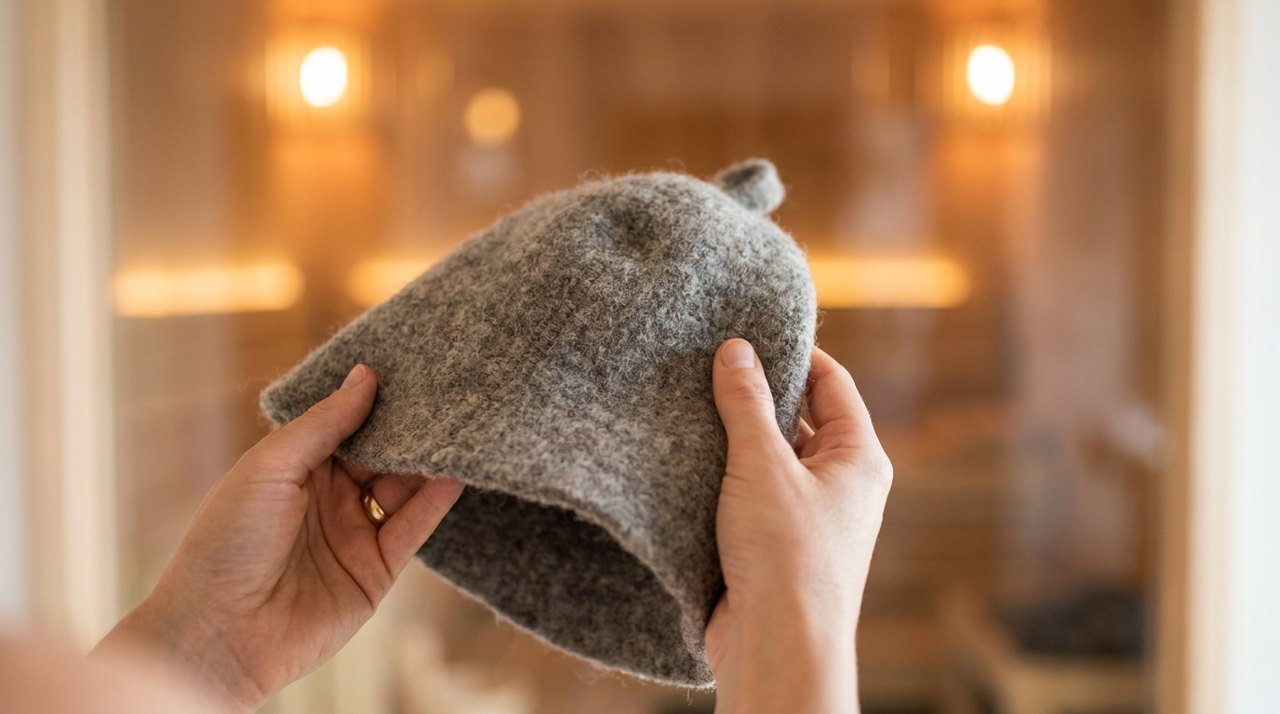
Walk into any sauna shop — or scroll any marketplace — and you'll find sauna hats from $8 to $60, in wool, felt, "felt-like fabric," cotton terry, and things the listing doesn't quite name. Most of them look nearly identical in photos. The differences that actually matter show up in the steam room: how well the hat insulates your head, whether it holds its shape after ten sessions, and whether it starts smelling like a wet gym bag. Here's the full checklist I run through before recommending any sauna hat, in the order that matters.
A sauna hat has exactly one job: keep your head cooler than the air around it. In a 90 °C (194 °F) sauna, the air near the ceiling — where your head sits — is the hottest spot in the room. Wool felt works because it traps a thick layer of still air in its dense, randomly-tangled fibers, and still air is one of the best insulators there is. Wool also absorbs a surprising amount of moisture (up to about a third of its weight) without feeling wet, which keeps its insulating power intact even when you're sweating.
Synthetics fail on both counts. Polyester and acrylic "felt" is thinner, traps less air, and — more importantly — softens and can deform at sauna temperatures. Some cheap blends will actually get hot to the touch because the plastic fibers conduct and hold heat rather than blocking it. If the physics interests you, I've written a full breakdown of why sauna hats work, explained by the numbers.
So the first checkbox is simple: 100% natural wool felt, no blends. Sheep's wool is the standard; some premium hats use a wool/felt mix with a small linen lining, which is fine — the shell doing the insulating should be pure wool.
You can't smell a product listing, but you can verify the hat the day it arrives, inside the return window. Two quick checks:
Among genuine wool hats, thickness is the next differentiator. You're looking for felt in the 3–5 mm range — dense enough that you can't easily see light through it when held up to a lamp. Under 2 mm, insulation drops off noticeably and the hat goes floppy when damp. Much over 6 mm and you're into decorative territory: heavy, slow to dry, no real added benefit.
Construction matters as much as the felt itself. The best hats are seamless-molded — felted directly over a hat form, so there are no seams to split. Stitched hats (made from felt panels) are fine if the seams are tight, flat, and reinforced; loose overlock stitching on the crown is where cheap hats fail first, usually within a few months of wet-dry cycles. Flip the hat inside out and tug gently at every seam before your first session.
Almost every wool sauna hat is sold one-size, and unlike one-size baseball caps, this genuinely works. Wool felt has memory: worn slightly damp (which it always is in a sauna), it relaxes and molds to your head over the first three or four sessions, then holds that shape. A new hat should feel snug but not tight — sitting low enough to cover the tops of your ears, since ears are thin, exposed, and among the first things to sting in a hot sauna.
If a new hat is slightly tight, wear it; it will give. If it's slightly loose, you can shrink it a touch by hand-washing in warm (not hot) water and air-drying on a smaller form. What you can't fix is a hat that's wildly oversized, so if you have a very large head (61 cm+), look for listings that state actual circumference rather than just "one size."
| Shape | Coverage | Best for | Trade-off |
|---|---|---|---|
| Classic bell (dome) | Full head + ears, tall air pocket above the crown | Hot saunas, long sessions, anyone who wants maximum function | The distinctive "gnome" look — you either love it or you don't |
| Bucket / brimmed | Head + ears, brim shades the face | People bothered by heat on the face and nose | Brim can droop when soaked; slightly less crown insulation |
| Cap / beanie style | Crown and ears, fitted | Milder saunas, steam rooms, subtle look | No insulating air gap above the head — measurably less effective in very hot rooms |
The tall bell isn't a costume choice — the air pocket between the felt and your scalp is part of the insulation. If you run your sauna at 90 °C or above, start with a bell. A well-made example is the DIVELUX wool sauna hat: 100% wool felt in the right thickness range, classic bell shape, and it hits every checkbox on this list. It's also available on Amazon if you'd rather keep it inside your Prime returns window for the smell test. If you want a brim or a different color, the DIVELUX sauna hats collection covers the other shapes in the same felt.
A good wool hat should last years, but only if you don't machine-wash it. The rules are short:
Here's the honest math: $15–25 is the sweet spot for a genuine 100% wool felt hat with proper thickness and construction. Below about $10, corners have been cut somewhere — thin felt, synthetic blend, or seams that won't survive a season. Above $35–40 you're mostly paying for embroidery, novelty shapes, or brand markup; the felt itself doesn't get meaningfully better. Hand-felted artisan hats from small makers can justify $40+ on craftsmanship, but they don't insulate better than a solid $20 hat.
Run any hat through those seven points and you'll almost never get burned — figuratively or otherwise. If you'd rather see how specific models stack up against this checklist, our 2026 buyer's guide to the best sauna hats does exactly that.
Handmade from 100% natural wool felt. 7 colors, classic and bucket styles, one size fits most. $19.99 with free US shipping and 30-day returns.
Shop DIVELUX sauna hats →